Showing posts with label Currency (Forex) Trading. Show all posts

Thursday, 27 March 2014

Currency Trading Basics


What is Currency Trading?


Currency Trading is the act of buying and selling (trading) different currencies of the world. The Foreign Exchange (or Forex) is the market that allows you to trade currencies in volume. A currency trader – whether bank, corporation, or individual – must be well acquainted and skilled in the ways of the Forex market, monitoring and acting on the subtle changes that indicate the potential for profit. 


Some Currency Trading Basics - 


How to read a Quote?


Because you are always comparing one currency to another, Forex is quoted in pairs. This may seem confusing at first, but it is actually pretty straightforward. For example, the EUR/USD at 1.5011 shows how much one euro (EUR) is worth in us dollars (USD).
What is a Lot?
A lot is the smallest trade size available. FXCM accounts have a standard lot size of 1,000 units of currency. Account holders can however place trades of different sizes, so long as they are in increments of 1,000 units like, 2,000, 3,000, 15,000, 112,000 etc.
What is a Pip?
A pip is the unit you count profit or loss in. Most currency pairs, except Japanese yen pairs, are quoted to four decimal places. This fourth spot after the decimal point (at one 100th of a cent) is typically what one watches to count "pips". Every point that place in the quote moves is 1 pip of movement. For example, if the EUR/USD rises from 1.5045 to 1.5051, the EUR/USD has risen 6 pips.
What is Leverage/ Margin?
Since, all trades are executed using borrowed money. This allows you to take advantage of leverage. Leverage of 50:1 allows you to trade with $1,000 in the market by setting aside only $20 as a security deposit. This means that you can take advantage of even the smallest movements in currencies by controlling more money in the market than you have in your account. On the other hand, leverage can significantly increase your losses. Trading foreign exchange with any level of leverage may not be suitable for all investors.
The specific amount that you are required to put aside to hold a position is referred to as your margin requirement. Margin can be thought of as a good faith deposit required to maintain open positions. This is not a fee or a transaction cost, it is simply a portion of your account equity set aside and allocated as a margin deposit.
What is Bid/ Ask Spread?

It is common for any currency pair to be quoted with both a bid and an ask price. The former, which is always a lower price than the ask, is the price at which a broker is ready and willing to buy, which is the price at which the trader should sell. The ask price, on the other hand, is the price at which the broker is ready and willing to sell, meaning the trader should jump at that price and buy.

Thank You !

Currency (Foreign Exchange) Markets


What are Currency (Foreign Exchange) Markets?


  • The Currency Trading Market(Forex Market) is a huge (3.2 Trillion US dollar) market where world currencies are exchanged back and forth on a daily basis. Currency Trading means buying and selling currency on the foreign exchange (or "Forex") market with the objective to make money,  


    • Currencies are the money of different countries, and currency trading is the buying and selling of these currencies. There are almost as many different currencies as there are countries, but the most popular currencies for trading are the US Dollar, the Euro, the British Pound (Sterling), and the Japanese Yen. 


      • The currency markets are one of the most popular day trading markets, and they therefore have some of the highest volume (number of contracts) and liquidity. This high volume and liquidity makes the currency markets attractive to all types of traders, including individual day traders, trading firms, financial and non financial companies, banks, and governments. For example, in Europe the currency in circulation is called the Euro (EUR) and in the United States the currency in circulation is called the US Dollar (USD). An example of a Forex trade is to buy the Euro while simultaneously selling US Dollar.


        • Currency markets are unique as they are not traded at exchanges, but are traded directly between traders instead. 


        Who trades currencies?


        • Currencies are traded by individual retail investors, financial and non-financial institutions , Banks & Governments and corporations doing business. Retail investors and banks trade to earn profits and corporations usually trade in the normal course of the international business process. trades are directly between two traders (or a trader and a Forex broker). This means that there could be several different exchange rates for the same currencies, depending upon factors such as the location of the traders, and the brokers being used.
        • Forex markets trade the currencies directly (rather than trading contracts), and the minimum amount that can be traded is known as a 'LOT'. The size of a lot is dependent upon the Forex broker being used. This amount is usually margined, so individual traders borrow most of the lot size from their Forex broker instead.


        Popular Currency Markets  


        • EUR / USD - The Euro to US Dollar exchange rate    
        • GBP / USD - The British Pound to US Dollar exchange rate
        • USD / JPY - The US Dollar to Japanese Yen exchange rate
        • CHF / USD - The Swiss Franc to US Dollar exchange rate
        • EUR / GBP - The Euro to British Pound exchange rate
        • AUD / USD - The Australian Dollar to US Dollar exchange rate
        • CAD / USD - The Canadian Dollar to US Dollar exchange rate
        • EUR / CHF - The Euro to Swiss Franc exchange rate

        Thank You !

        Understanding Forex Chart and it's influence

        How to Read a Forex Chart


        Forex traders have developed several methods for attempting to figure out the direction of a currency pair. Technical traders use charting tools and indicators to identify trends and important price points of where to enter and exit the market. But no matter what type of trader you are, you'll need to learn how to read Forex charts...
        Using Candlestick Charts 
        Forex Charts


        The default chart type is called a ‘candlestick' chart. This chart type is used frequently in the Forex market. A bar on a candlestick chart shows the open, close, high and low prices for the selected period. The body of the candle shows the open and close prices where the wicks show the high and low prices. 
        If the closing price is higher than the opening price of the previous candle, then the candlestick will be blue. If instead the closing price is lower than the opening price of the previous candle, then the candlestick will be red. Candlesticks simply make it easier to see if the trading period ended up or down.
        Adding an Indicator

        Just looking at Forex charts can be helpful in making a trading decision, but many traders also use technical indicators to help them make more informed trading decisions. These tools help a trader locate price trends and predict future price movements. The trading station is equipped with over thirty popular pre-loaded indicators. Over six hundred popular and custom indicators are downloadable online. To add an indicator to a chart, right click on the chart and select ‘add indicator.
        Drawing a Trend Line 

        Prices trend in one of three ways: up (bull market), down (bear market) or sideways (range bound market). A trend line is used to help a trader visually recognize which trend direction is in place. Until the trend is "broken," a trader can reasonably expect the trend to continue. Trend lines are drawn with the ‘pencil' tool. Typically, when you draw a trend line, you want to connect two or more extreme high or low prices that define the trend. Here are a few examples:

         UP TREND
                                                                                                                            

        Live Up Trend (Bull Market) Forex Chart

        DOWN TREND


        Down Trend (Bear Market) Forex Trading Chart


        HORIZONTAL TREND
        Horizontal Trend (Range Bound Market) Forex Charting


        How Currency Exchange Rate affects a nation - 


        Currency Exchange rates play a vital role in a country's level of trade, which is critical to most every free market economy in the world. For this reason, exchange rates are very popularly analyzed and government manipulated economic steps. Currency Values change due to several factors. Sometimes they may change due to political and economic factors, and sometimes they react to other external changes as well. But before going into the factors, we must know how a movements in Exchange Rate influence a country's trading relationship with other country. A higher Currency rate makes a nation's exports more expensive and and Import's cheaper in the Foreign Market and vice verse. A higher exchange rate lowers the country's Balance of Trade and Balance of Payment, while a lower exchange rate would increases them.


        Why does Currency Value change? 


        • Inflation Levels- A country with lower Inflation Rate have rising value in Currencies as the power of purchasing increases relatively as compared to countries that are exhibiting higher Inflation Rate and vice verse. 


        • Interest Rates - Interest Rates, Inflation & Exchange Rates are highly co-related with each other. Higher interest rates offer lenders in an economy a higher return compared to other countries. Thus, higher interest rates attract foreign capital and cause the exchange rate to rise and vice verse.


        • Debts and Debtors - A large Debt rises Inflation levels and we know what effect does rise in Inflation levels have with Exchange Rate. A large debt usually means that the debt will be paid off with cheaper price and thus countries having large debts are less attractive to Foreign Investors.


        • Trading Terms - By trading terms, we mean the ration between export price to import price. If a country's exports increase at a greater rate than it's imports, then it means that the trading terms have done well and is favorable. Hence, an increase in country's terms of trade shows a greater demand for exports, and thus increased demands for country's currency and subsequently Currency Value.


        • Political Stability and Economic Performance -  Foreign investors inevitably look out for politically and economically sound countries to invest their capital. A country with such positive factors will draw more investment funds and away from other countries which are perceived to have greater political and economic risk and turmoil. 


        How Currency Trading (Forex) works?

        The currency exchange rate is the rate at which one currency can be exchanged for another currency. Currency market trading symbols are constructed using the two currencies that are being traded. For example, the trading symbol for the Euro to US Dollar market would be EUR/USD. Each currency market has a minimum price change (tick size), and a minimum trading amount, with which the value per minimum price change can be calculated. It is always quoted in pairs like the EUR/USD (the Euro and the US Dollar).


        For example, The GBP/USD rate represents the number of US Dollars one GBP ( British Pound) can purchase. If we think that the GBP ( British Pound) will increase in value against the US Dollar, we will buy British Pounds with US Dollars. If the exchange rate rises, we will then sell the British Pounds back, making a profit. 


        How risky is currency trading ? 


        Currency trading can be very risky indeed. 

        Currencies tend to be very volatile compared to other markets. The real key to success with currency trading is to use efficient risk management strategies to keep a control of the above mentioned factors that influences exchange rates. There are many components to effective currency risk management, but the bottom line is to use caution and have a trading plan.


        Thank You !

        Online (Forex) Trading


        What is Online Currency (Forex) trading?


        Online Forex trading is the trading of one currency for another through the use of the internet. The Forex market is actually the largest financial market in the world and it is an over the counter (OTC) market. This means that there is no centralized location like the New York Stock Exchange from which trading activities must take place. Because of this unique aspect of the Forex market, with online Forex trading, one can deal in Forex from any place in the world. In addition, with online Forex trading, it is possible to trade in Forex around the clock five days in a week without having to leave the house. 


        Advantages - 
        Online Forex trading has become very popular in the past decade because it offers traders several advantages:
        Forex Never Sleeps
        Trading goes on all around the world during different countries' business hours. You can, therefore, trade major currencies at any time, 24 hours per day. Since there are no set exchange hours, it means that there is also something happening at almost any time of the day or night.


        Go Long or Short
        Unlike many other financial markets, where it can be difficult to sell short, there are no limitations on shorting currencies. If you think a currency will go up, buy it. If you think it will fall, sell it. This means there is no such thing as a "bear market" in Forex - you can make (or lose) money any time.
        Low Trading Costs
        Most Forex accounts trade without a commission and there are no expensive exchange fees or data licenses. The cost of trading is the spread between the buy price and the sell price, which is always displayed on your trading screen.
        High Liquidity
        Because Forex is a $4 trillion a day market, with most trading concentrated in only a few currencies, there are always a lot of people trading. This makes it typically very easy to get in to and out of trades at any time, even in large sizes.
        Available Leverage
        Because of the deep liquidity available in the Forex market, you can trade Forex with considerable leverage (up to 50:1). This can allow you to take advantage of even the smallest moves in the market. Leverage is a double-edged sword, of course, as it can significantly increase your losses as well as your gains.
        International Exposure
        As the world becomes more and more global, investors hunt for opportunities anywhere they can. If you want to take a broad opinion and invest in another country (or sell it short!), Forex is an easy way to gain exposure while avoiding vagaries such as foreign securities laws and financial statements in other languages. 

        Thank You !

        Forex Currencies: Trading Strategies

        Investing is an exciting opportunity that can provide short-term gains and long-term financial security when done properly. There are variety of Currency ( Forex) Trading strategies available. Following outlines the most common strategies.

        Currency Analysis 


        One of the easiest Forex trading strategies is known as currency analysis. This is a very effective method of predicting market movements and currency fluctuations. There are two different methods used to analyze currency: Technical analysis and Fundamental analysis.

        Day Trading

        This is one of the most popular Forex trading strategies and it is employed by both beginners and experienced investors. A day trader, will not hold any trading positions overnight. He may make multiple trades within a single day but he needs to liquidate all of his trading positions before the market closes.
        But the longer one holds a trading position, the higher his risk of losing on the trade. By studying the currency fluctuations on a daily basis, it becomes apparent that practically every currency fluctuates throughout the day. Although these price fluctuations may be small, many trades over the course of a single trading day can result in significant profits.
        Many experts recommend that day traders use significantly more investment capital than some of the other strategies mentioned because the fluctuations are magnified with larger amounts of money. Since Forex relies on leverage, it is relatively easy to make large trades without having a lot of capital on hand. The drawback in this system is that one can easily lose money that one cannot afford to repay if leverage works against you during a particular trading day.

        Range Trading

        Sometimes also known as support and resistance levels. This system relies on the fact that each currency has price fluctuations throughout the day and the week that remain relatively constant.
        Many commonly trading currencies have relatively predictable price movements and by studying the charts for a few days, identifying the trading signals is straightforward. For instance, if a currency generally fluctuates between $1.4 and $1.7 throughout the day, these would represent your trading signals. The support price is $1.4 – this is when you want to purchase this particular currency. The resistance price is $1.7. As the currency value approaches this number, one would want to trade out of the position and extract profits.
        As you can see, the key to this method is studying the average fluctuations of your target currency well enough to identify the support and resistance prices. Although the profits generated using this range trading strategy are typically not as significant as traditional day trading or currency analysis, the consistent profits you can reap using this method make it one of the better options to consider as a novice Forex investor.
        Some other yet very popular Currency Trading Techniques are : Hedging and Speculating 


        Friday, 21 March 2014

        Hedging in Currency (Forex) Market


        What is Hedging?


        • Currency hedging is the act of entering into a financial contract in order to protect against unexpected, expected or anticipated changes in currency exchange rates. Currency hedging is used by financial investors and businesses to eliminate risks they encounter when conducting business internationally. 
        • Hedging can be accomplished by purchasing different types of contracts that are designed to achieve specific goals. These goals are based on the level of risk the customer is exposed to and seeking protection from and allow the individual to lock in future rates without affecting, to a great extent, their Market Liquidity.


        Methods of Hedging Currency Trades 

        1. Spot contracts
        2. Foreign currency options


            • Spot contracts are essentially the regular type of trade that is made by a retail Forex trader. Because spot contracts have a very short-term delivery date (two days), they are not the most effective currency hedging strategy. 


            • Foreign currency options, however are one of the most popular methods of currency hedging. As with options on other types of securities, the foreign currency option gives the purchaser the right, but not the obligation, to buy or sell the currency pair at a particular exchange rate at some time in the future.


            Forex Hedging Strategy 


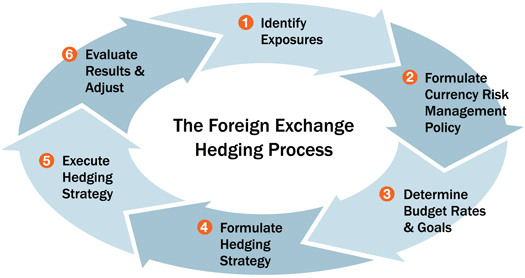
            A Forex hedging strategy is developed in four parts, including an analysis of the Forex trader's risk exposure, risk tolerance and preference of strategy. These components make up the Forex hedge:

            • Analyze risk: The trader must identify what types of risks he is taking in the current or proposed position. From there, the trader must identify what the implications could be of taking on this risk un-hedged, and determine whether the risk is high or low in the current Forex currency market. Right analysis of risk is essential.

            • Determine risk tolerance: In this step, the trader uses their own risk tolerance levels, to determine how much of the position's risk needs to be hedged. No trade will ever have zero risk; it is up to the trader to determine the level of risk they are willing to take, and how much they are willing to pay to remove the excess risks. So, this level is dependent on the risk factor.

            • Determine Forex hedging strategy: If using foreign currency options to hedge the risk of the currency trade, the trader must determine which strategy is the most cost effective.

            • Implement and monitor the strategy: By making sure that the strategy works the way it should, risk will stay minimized and never cause any dramatic problems.


            The Forex currency trading market is a risky one, and hedging is just one way that a trader can help to minimize the amount of risk they take on.

            Speculating in Currency (Forex) Market


            What is Speculating? 


            • This is the broad category under which activities of most investors fall, which involves buying or selling a financial asset, usually in the face of higher-than-ordinary risk, in order to take advantage of an expected move. Speculators in the currency market wager that, in the future, the value of a currency will move higher or lower relative to another currency. In addition to individual investors, speculators in the currency market can include hedge funds, commercial banks, pension funds or investment banks.

            Roles of Speculators


            Speculators play one of three primary roles in financial markets, 


            • Hedgers who engage in transactions to offset some other pre existing risk, 

            • Arbitrageurs who seek to profit from situations where interchangeable instruments (goods that consist of many identical parts which can be easily replaced by other, identical goods) trade at different prices in different market segments

            • Investors who seek profit through long-term ownership of an instrument's underlying attributes. The role of speculators is to absorb excess risk that other participants do not want, and to provide liquidity in the marketplace by buying or selling when no participants from the other categories are available.


            • It may sometimes be difficult to distinguish between speculation and investment, and whether an activity qualifies as speculative or investing depends on a number of factors, including the nature of the asset, the expected duration of the holding period, and the amount of leverage.  


            By taking advantage of already unstable currencies, Speculation can sometimes create more instabilities also. National banks will sometimes react to stabilize their currency, though it is unclear as to exactly how much of an effect that they can have. Market forces sometimes overwhelm the attempts of a central bank to stabilize its national currency, as the combined strength of worldwide Forex investors often outstrips the purchasing power of national banks.


            Thank You !

            Balance of Payment

            What is Balance of Payment? 

            Balance of payments of a country will cause the exchange rate of its  domestic currency to fluctuate. The balance of payments is a summary of all economic and financial transactions between the country and the rest of the world. It reflects the country’s international economic standing and influences its macroeconomic and micro-economic operations.The balance of payments can affect the supply and demand for foreign currencies as well as their exchange rates.


            • Balance of Payment is a system of recording all the economic transactions of a country, with the rest of the world over a period, say one year.
            • Typically, the transactions included in BOP are country's exports and imports of goods, services, financial capital, and financial transfers. Thus, in nut shell we can say, the BOP accounts summarize international transactions for a specific period, usually a year, and are prepared in a single currency, typically the domestic currency for the country concerned.

            Components of Balance of Payment - 

            The components of BOP are as follows - 

            • Current Account - (Net export/import of goods (trade balance) Net export/import of services Net income (investment income from direct and portfolio investment plus employee compensation) Net transfers (sums sent home by migrants and permanent workers aboard, gifts, grants and pensions)
            • Capital Account - (Capital transfers related to the purchase and sale of fixed assets such as real estate
            • Financial Account - (Net foreign direct investment Net portfolio investment Other financial items 
            • Net errors and Omissions Account - (Missing data such as illegal transfers)
            • Reserves and related items: official reserve account - (Official reserve account Changes in official monetary reserves including gold, foreign exchange, and IMF position.

            Calculation of Balance of Payment


            BOP = BOT + (Net Earning  on foreign investment i.e. payments made to foreign investors) + Cash Transfer + Capital Account + or - Balancing Item

            or

            BOP = Current Account + Capital Account  + or - Balancing item ( Errors and omissions)


            Favorable & Unfavorable Balance of Payment (Surplus & Deficit)

            • Balance of Payment will be favorable, if  the country has surplus in current account for paying your all past loans in her capital account.


            • Balance of payment will be unfavorable, if the country has current account deficit and it took more loan from foreigners. After this, it has to pay high interest on extra loan and this will make  BOP unfavorable.

            Factors affecting Balance of Payments

            • Conditions of foreign lenders. 
            • Economic policy of Govt. 
            • The cost of Production (Land, Labor, Capitals, Taxes, Incentives) in the exporting economy vis-a-vis those in the importing economy.
            • The cost of availability of Raw materials, Intermediate goods and other inputs.
            • Exchange Rate Movements.
            • Different levels of Taxes or restrictions on trade.
            • External or unavoidable factors like environmental, health or safety standards.
            • The availability of adequate foreign exchange with which to pay for the imports.
            • Price of goods manufactured at home in response to supply.


            Significance of Balance of Payment


            • Judge economic and financial status of a country in the short-term.
            • In the case of a developing country, the balance of payments shows the extent of dependence of the country’s economic development on the financial assistance by the developed countries.
            • Deficit signifies a tendency to take stiff measures for diminishing imports, exchange control and restrictions on repatriation of dividends/ interest.
            • It helps the government in taking decisions on monetary and fiscal policies on the one hand, and on external trade and payments issues on the other.

            Thank you !